

Fossils and Fossilisation
Fossils are the preserved remains or traces of plants and animals that lived millions of years ago. They provide valuable evidence about past life on Earth, ancient environments, and how continents were once connected. Most fossils are found in sedimentary rocks, where layers of sediment help protect remains over long periods of time.
What Are Fossils?
Fossils can be the remains of living things, such as bones, shells, or teeth, or they can be traces of life, including footprints, burrows, or leaf impressions. By studying fossils, scientists can learn about extinct species, how organisms have evolved, and what Earth’s climate and landscapes were like in the past.
Fossils also helped support the theory of continental drift, as identical fossils have been found on continents now separated by oceans.


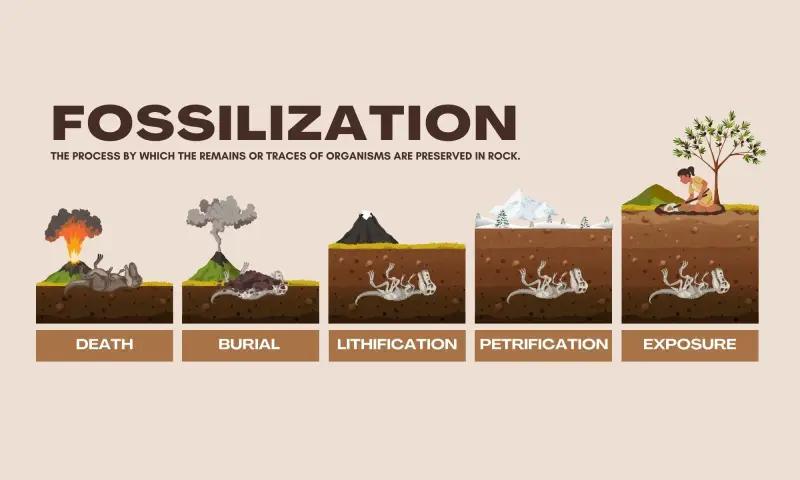
The Fossilisation Process
Fossilisation is rare and only occurs under specific conditions. Most living things decay quickly after death, but fossilisation can happen if remains are buried rapidly.
Step 1: Death
An organism dies, often near water such as a river, lake, or sea.
Step 2: Burial
Sediment such as sand or mud quickly covers the remains, protecting them from decay and scavengers.
Step 3: Compaction and Cementation
Over time, more layers of sediment build up. Pressure increases and minerals begin to replace the original material.
Step 4: Fossil Formation
The remains slowly harden into rock, forming a fossil within sedimentary layers.
Step 5: Exposure
Movement of the Earth’s crust, erosion, or weathering may eventually expose the fossil at the surface.
Types of Fossils
Body Fossils
These include actual remains such as bones, shells, or teeth.
Trace Fossils
These include footprints, burrows, and feeding marks left behind by organisms.
Moulds and Casts
A mould forms when an organism dissolves away, leaving an impression. A cast forms when this impression fills with minerals.
