Plate boundaries are the edges where tectonic plates meet and interact. These boundaries are responsible for many of the Earth’s most powerful natural processes, including earthquakes, volcanoes, and mountain building. The movement of plates along these boundaries is driven by forces deep within the Earth and has shaped the planet over millions of years. Understanding plate boundaries helps explain how supercontinents such as Pangea broke apart and why the Earth’s surface continues to change today.
Constructive Plate Boundaries
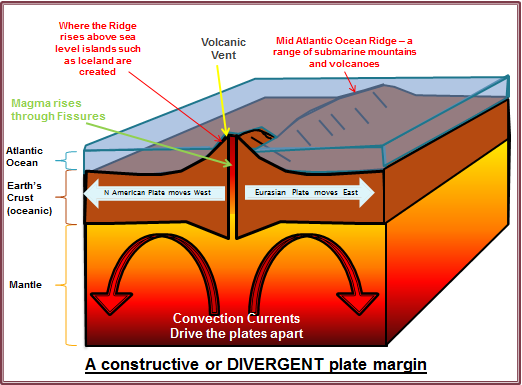
Constructive plate boundaries occur where two tectonic plates move away from each other. As the plates separate, molten rock from the mantle rises to fill the gap. This magma cools and solidifies, creating new crust. Over time, this process can form mid-ocean ridges and volcanic activity along the boundary.
Most constructive boundaries are found beneath the oceans, where they create long chains of underwater mountains. However, in some places, such as Iceland, constructive boundaries can be seen above sea level. These boundaries are called constructive because new land is constantly being formed as the plates move apart.
Destructive Plate Boundaries
Destructive plate boundaries occur where two tectonic plates move towards each other. When this happens, the denser plate is forced beneath the less dense plate in a process known as subduction. As the plate sinks into the mantle, it melts, producing magma that can rise to the surface and cause volcanic eruptions.
These boundaries are called destructive because crust is destroyed as it is recycled back into the Earth. Destructive boundaries are responsible for some of the world’s most powerful earthquakes, deep ocean trenches, and volcanic mountain chains. Many of these features can be found around the edges of the Pacific Ocean, an area often referred to as the Ring of Fire.
Conservative Plate Boundaries
Conservative plate boundaries occur where two tectonic plates slide past each other horizontally. At these boundaries, the plates do not move apart or collide, so no new crust is created and none is destroyed. Instead, friction builds up as the plates become locked together.
When the pressure becomes too great, the plates suddenly slip, releasing energy in the form of earthquakes. Conservative boundaries can produce some of the most powerful earthquakes on Earth but are not usually associated with volcanic activity. A well-known example of a conservative boundary is the San Andreas Fault in California.